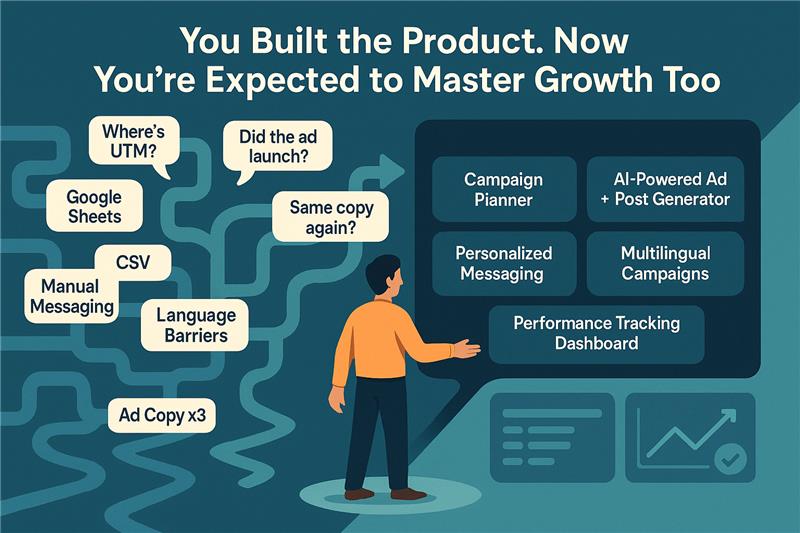
You didn't start this company to write ad copy. You didn't raise a seed round to spend hours figuring out why your Facebook ad didn't deliver.
You started because you saw a gap. A real one. You built something bold. You launched.
But now you're here—juggling ad accounts, switching between Google Sheets and Meta dashboards, wondering if your CAC numbers are even accurate.
You thought traction would be about product–market fit. But no one told you how much of it would come down to managing marketing chaos.
From MVP to GTM: When Growth Gets Real
In the early days, growth is exciting. You write the copy yourself. Run a few ads. Hack together creatives in Figma. Test messaging. Iterate.
Then traction begins.
You start managing multiple channels—Google, Meta, Instagram, maybe LinkedIn or WhatsApp. You bring in a freelancer or a small agency to help. Suddenly, your Notion dashboard is flooded with campaign drafts, incomplete reports, and messages like "Did we ever launch the second ad group for the new user segment?"

This is when most founders realize that growth isn't just about ambition—it's about systems.
The Hidden Costs of "Just Running Ads"
As growth becomes more structured, it also becomes more fragmented. Here are the most common friction points that show up as your startup scales its marketing.
Context Switching That Drains Momentum
You're building the product and chasing distribution at the same time. That means:
- Writing campaign briefs without a dedicated marketer
- Approving creatives across three tools
- Reviewing performance for five ad sets
- Answering investor questions with half-baked reports
The mental load grows disproportionately. For lean teams, that's dangerous.
Reporting Becomes a Black Hole
Everyone wants data. But no one has time to compile it properly.
- Your investors need clear CAC and retention insights.
- Your team wants direction.
- You just want to know if your campaigns are converting.
Instead, you're sifting through screenshots, exporting half-broken CSVs, and trying to make sense of dashboards that don't talk to each other. By the time the report is ready, the campaign is already irrelevant.
Founders don't need more numbers. They need exportable, structured reports that tell a clear, timely story.
Your Messaging Isn't Keeping Up with Your Market
In the first few months, you know exactly how to talk about your product.
Then you start scaling. Some users love you. Some are confused. Some bounce after the first visit.
You still have only three versions of ad copy—all written months ago. You're not ignoring feedback; you just don't have time to interpret it, rewrite everything, and A/B test all over again.
This is where AI-driven content recommendations can be a serious edge—pulling insights from actual user behavior, comments, and sentiment to improve what you say and how you say it.
You're Serving a Multilingual Market with Monolingual Ads
If your audience is in India, Southeast Asia, LATAM, or even in global diaspora communities, there's a good chance English isn't the only—or even the preferred—language.
But most early-stage campaigns default to English. Not because it performs best, but because it's easier.
Now, imagine generating your campaigns in English, Hindi, Bengali, or Tamil with consistent tone and context, without needing separate agencies or hours of translation. For startups, that's not just a localization strategy—it's a growth unlock.
What Growth-Stage Founders Are Doing Differently
The smartest founders aren't trying to do it all. They're building workflows that take the weight off their team—without sacrificing control or insight.
Here's what's becoming standard in modern startup growth stacks:
- Cross-channel campaign orchestration from a single interface
- Sentiment-based content suggestions to refine messaging based on real feedback
- Exportable performance reports, ready for team syncs or investor updates
- Multilingual campaign support for diverse audiences
- Repeatable workflows that don't need to be rebuilt for every launch
You Didn't Sign Up to Be a Marketer
But marketing became part of your job. And at this stage, it's not about spending more or hiring faster. It's about simplifying execution.
So if growth feels heavy right now, pause and ask:
- Is it the strategy that's not working?
- Or is the execution layer holding everything back?
The startups scaling faster aren't always building more features. They're removing the drag from the marketing engine—one process at a time.
Because clarity isn't just good for your team. It's what unlocks real, sustainable growth.